
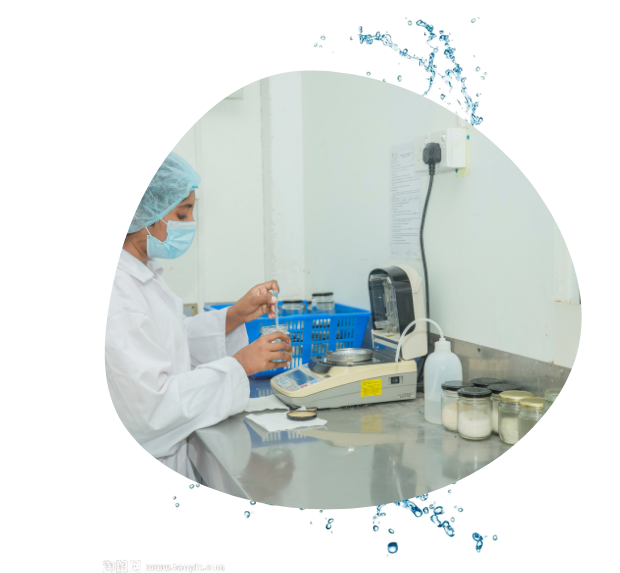
mateCeylon is committed to satisfying our customers by producing hygienically safe organic coconut-based products without any microbiological, chemical, or physical food safety hazards, selling them with consistency, conforming to quality and food safety standards, and focusing on customer requirements. We create awareness among all our employees and stakeholders about quality control programs to successfully implement a food safety culture.
We have implemented well-structured quality control criteria required by international quality standards like ISO 22000, HACCP, and Kosher from international quality management bodies. We have also engaged in organic farming and production practices and proved that organic farming and production meet internationally recognized organic standards such as EU Organic and USDA Organic. We have introduced advanced production technology to enhance our quality assurance process.
We are improving our quality assurance process through continuous monitoring, regular training, periodic auditing, and evaluating customer feedback to enhance the brand of "mateCeylon" products.
The BRCGS (Brand Reputation through Compliance Global Standards) Food Safety Certification is a globally recognized standard that ensures strict compliance with food safety, quality, and legal requirements. It is widely used by food manufacturers, suppliers, and retailers to maintain high safety standards and consumer trust. This certification guarantees:
 Rigorous food safety management systems to prevent contamination and hazards.
Compliance with international regulations and best practices in food production.
Consistent product quality through strict hygiene and manufacturing protocols.
Traceability and transparency in sourcing, processing, and distribution.
Organic is a labelling term that indicates that the food or other agricultural product has been produced through approved methods. The organic standards describe the specific requirements that must be verified by a USDA-accredited certifying agent before products can be labelled USDA organic.
USDA-certified organic foods are grown and processed according to federal guidelines that address, among many factors, soil quality, animal raising practices, pest and weed control, and the use of additives. Organic producers rely on natural substances and physical, mechanical, or biologically based farming methods to the fullest extent possible.
Overall, organic operations must demonstrate that we are protecting natural resources, conserving biodiversity, and using only approved substances
The European Certificate of Organic Agriculture allows our organic produce to be commercialized within the European Union. The European certificate and EU regulation on organic production and labelling of organic products ensure that the same high-quality standards are respected all over the EU. The rules refer to agriculture and aquaculture farming practices, food processing and labelling, and certification procedures for farmers.
Organic farmers in the EU use energy and natural resources in a responsible way, promote animal health, and contribute to maintaining biodiversity, ecological balance, and water and soil quality
ISO 22000 is an internationally recognized certification scheme that specifies the requirements for a comprehensive food safety management system. It incorporates elements of Good Manufacturing Practice (GMP) and HACCP (Hazard Analysis Critical Control Points) and covers all processes in the food chain, from farming, food processing, and packaging to transportation, storage, and retail.
ISO 22000:2018 Food Safety Management System harmonizes various national food safety standards into one easy-to-understand set of requirements. It provides global recognition of your commitment to safety in food, beverage, ingredient, and pet food supply chains and helps you to:
Control and reduce food safety hazards.
Demonstrate a commitment to food safety.
Sell your products through the food supply chain more easily.
Gain a competitive advantage.
Demonstrate the integrity of our manufacturing processes and compliance with food safety regulations. HACCP (Hazard Analysis and Critical Control Point) is an internationally recognized standard that defines the requirements for the effective control of food safety. It should be applied during the manufacture of food, ingredients, and beverages and is a key element of the CODEX General Principles of Food Hygiene.
HACCP is built around seven principles:
Conduct a hazard analysis of biological, chemical, or physical food hazards.
Determine critical control points.
Establish critical control limits, for example, minimum cooking temperature and
time.
Establish a system to monitor the control of critical control points
Establish corrective actions.
Establish procedures for verification to confirm that the HACCP system is working
effectively.
Establish documentation and record-keeping.
The Kosher certificate is a document issued by certification agencies and the Chief Rabbinate of Israel in which a Rabbi certifies that the products referred to (usually food products) fulfill the biblical precepts of the Jewish religion. This certificate is not only required for Israel but also for other countries in which there are Jewish communities calling for kosher products, such as the USA, United Kingdom, France, Russia, Argentina, or Mexico. Kosher certificates are requested especially for foods such as meat (slaughter of animals and salting process), fish, milk, and eggs, as well as canned and preserved foods. Products that are kosher certified are often marked with a kosher symbol, or simply the letter K
The process of kosher certification involves a careful examination of all ingredients used in the production process as well as a thorough inspection of the manufacturing facility itself. Companies must also provide evidence that all ingredients used in their products are certified as being fit for consumption under Jewish dietary laws. Additionally, any machinery or equipment that comes into contact with the food products must be formally certified as being suitable for use in producing kosher foods.


Enjoy the best quality coconut products from this tropical paradise island.
Organically grown coconuts are sourced for all products.
Manufacturing and distributing our products locally for 12 years.
We have an ethical business practice with our communities.